According to the capital allocation policy approved by the shareholders in April last year, Infosys plans to give back around Rs 10,400 crore to shareholders by the end of this financial year.

With this, the total strength of TCS's board has increased to 11.

In 2010, TCS's brand value was $2.3 billion.

As the job markets open up, top IT services firms may look at a tiered strategy in which they hire entry-level talents at higher salaries, amid a major technological shift, say HR analysts.

From the Sensex pack, Tata Motors, Sun Pharma, Wipro, Tata Consultancy Services, UltraTech Cement, Tech Mahindra, Bajaj Finserv, HCL Technologies, Infosys and IndusInd Bank were the major laggards. NTPC, Power Grid, Reliance Industries, Tata Steel, HDFC and HDFC Bank were the major winners.

Though a weak dollar will lend some support to revenues and margins in FY21, the demand environment will outweigh any gain.

Companies now require more than just academic marks; they seek students with internship experience or extra certification courses.

US is the largest market for the over $140 billion Indian IT services industry

Seven consecutive sessions of decline in the equity market has eroded the wealth of investors by a whopping Rs 10.42 lakh crore and the benchmark Sensex has tumbled more than 2,000 points during this period. Concerns over more rate hikes by developed economies, weak global equity markets and fresh foreign fund outflows from the domestic market have dented investor sentiments. On Monday, the BSE Sensex dropped 175.58 points or 0.30 per cent to end at 59,288.35 points, marking a decline for seven straight trading sessions.
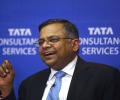
India's largest software services firm Tata Consultancy Services (TCS) said the tenure of its Chief Executive Officer and MD N Chandrasekaran has been extended by five years to October 2019.

The Ebitda margin, too, was lower than the expected 29.1 per cent.

Ukraine is currently in the middle of a strategic offensive into Russia's Kursk region.

By the end of the June quarter, the top four - TCS, Infosys, Wipro and HCL Tech employed 10,15,000 employees - down by 9,144 employees over the previous quarter.

Large Indian IT services companies are expected to report "muted" sequential show in a traditionally strong second quarter, as macroeconomic challenges continue to weigh on global discretionary spending, say market watchers. The big earnings week for tech heavyweights is up ahead, with Tata Consultancy Services (TCS) scheduled to announce its results on October 11, and both Infosys and HCL Technologies on October 12. Wipro is slated to declare its Q2FY24 results next week, on October 18.

Most of the large Indian IT services players, such as TCS, Infosys, Wipro, and HCL Tech, have signalled increased offshoring efforts and opting for local hires in the US, primarily to address the immigration-related challenges.

Equity benchmark indices Sensex and Nifty buckled under selling pressure after a nine-session rally on Monday, as massive sell-off in IT, tech and telecom counters unnerved investors.

With the last quarter of 2023-24 (FY24) expected to have been soft owing to lower discretionary spend and macro uncertainty, many are hoping FY25 will be a year of recovery for the information-technology (IT) industry. The fourth quarter, January-March, is considered soft, and will continue to see the headwinds the sector has been facing. And the sector has entered the new financial year on a weak footing. Analysts are expecting Tier-I firms to report sequential growth of -1 per cent to 1.5 per cent and midcap players' growth may range between 0.7 per cent and 4 per cent.

Dip in attrition rates and higher bench strength seem to be signalling a normal year for hiring in FY24.

From the Sensex pack, Infosys, HCL Technologies, Infosys, NTPC, Mahindra & Mahindra, Tata Consultancy Services, Nestle, Tech Mahindra and Bajaj Finance were the major gainers. Power Grid, Larsen & Toubro, Maruti, Titan, HDFC Bank, Wipro, HDFC and ITC were among the laggards.

'Our focus on fresher induction is high, given that they come in with certain advantages.' 'They do not have an unlearning process as seen in senior employees.'

This business could also be aided by new outsourcing opportunities in IMS from Germany, France and northern Europe

While discretionary spend by global enterprises is likely to negatively impact all Indian IT firms, more revenues from products and less exposure to financial services segment are likely to lessen the impact for HCL Technologies and Tech Mahindra.

On Aug 28-31, an average of 1.5 mn e-filed tax returns a day, against IRCTC's daily average bookings of 600,000 & Flipkart's 100,000.

Google has emerged as top choice in the Top 100 Ideal Employer Rankings in a survey conducted among Indian management and engineering students.

Such partnership will not only give the company an opportunity to showcase its expertise in new technology areas, they will also help in boosting its brand image with clients and employees
Shares of HCL Tech hit a fresh record high of Rs 1,118.55 on Friday, up 2 per cent on the BSE in intra-day trade, surpassing its previous high of Rs 1,101 touched on Thursday in intra-day deals.

Indian IT services companies have seen several CEO changes that have, over the past few months, led to some crucial exits at the mid-senior level in a trend that is likely to continue. According to a recent Motilal Oswal report, "Movement of mid-to-senior leadership at IT services firms is a reality, partially on account of multiple CEO-level changes.
The gauge for the performance of informational technology (IT) stocks soared nearly 5 per cent-most in nearly three years-as growth worries eased following a robust order book posted by bellwether Tata Consultancy Services (TCS). The Nifty IT index rose 4.5 per cent to close at 30,945. This was the biggest single-day gain since September 14, 2020. Industry titan TCS' shares rose 5 per cent to Rs 3,509.
The results of Indian IT services players in the just-concluded fourth quarter of 2021-22 are expected to reveal continuing growth momentum as demand surges on the back of digital transformations and the cloud shift, but analysts anticipate margins to be under pressure due to supply challenges. Analysts covering the sector expect revenue commentary should be strong despite the Russia-Ukraine conflict and inflation. Top-line growth will be driven by broad-based demand with a strong uptick for cloud, digital, cybersecurity, data analytics, and artificial intelligence, among other services.

Most of the hirings are, however, in the entry or junior level.

'The top five IT giants are not hiring, but most of the freshers want to start their careers with the top five IT firms.' 'In today's scenario this is a challenge.'

Infosys, however, feels the high level of cash is an important tool to weather tough times.

Stock market crash: TCS sheds $21 billion in market capitalisation, Infosys $7 billion and Wipro around $3 billion

A company with a size exceeding $1 billion finds it really hard to innovate.

Shares of Tata Consultancy Services on Wednesday plunged almost 4 per cent, wiping out about Rs 16,000 crore (Rs 160 billion) in investor wealth, after the IT major indicated to analysts that weak India business and lower working days could drag down March quarter growth rate.

Around 1,680 deals worth over $80 billion will be renewed next year. Among Indian vendors, Infosys, TCS, and HCL Technologies are better placed to see a higher growth rate in 2020.

Morgan Stanley has increased the target prices of certain information technology (IT) stocks by as much as 29 per cent, anticipating an improvement in earnings in the near future. Within the IT and engineering research and development (ER&D) services sector, it is now more optimistic about growth and margin estimates for 2024-25 (FY25).
Strong macroeconomic headwinds causing turbulence in the $245-billion Indian IT industry are yet to calm down. Top Indian IT services companies are likely to post a decline or just marginal growth in sequential revenue in Q1FY24 because of a soft discretionary spending environment. Though the first quarter is seasonally strong for IT firms, "June 2023 will be an exception", according to analysts at Kotak Institutional Equities.

The Nifty IT index rose by 5.14 per cent on Friday (January 12), marking its best performance in a day since July 2020, followed by another 1.9 per cent rally on Monday. With this, the index, which tracks the share prices of India's 10 biggest information technology (IT) services companies, has increased 7.1 per cent in the past two sessions. However, the substantial rally in the index occurred at a time when India's four largest IT companies reported their worst quarterly performance in over five years.

Brokerages expect India Inc to report an upturn in earnings for the March quarter of 2022-23, after a relatively muted showing in the previous two quarters. This growth is expected to be led by banking, financial services and insurance (BFSI) companies, FMCG firms, and automobile makers. The combined net profit of the Nifty50 companies (excluding Adani Enterprises) is expected to have grown 15.6 per cent to Rs 1.77 trillion in Q4FY23, from Rs 1.53 trillion a year ago.
